🌿 The Complete Spring Gardening Toolkit
Every Tool I Actually Used This Season — and Why It Earned Its Place
Disclosure: This post contains affiliate links. If you purchase through these links, I may earn a commission at no additional cost to you.
Spring always feels like a fresh start—but standing in the garden, it can also feel overwhelming. Where do you even begin?
There is a particular satisfaction that comes at the end of spring cleanup — standing back and looking at beds that are clear, shaped, and ready. But getting there requires the right tools in the right hands at the right moment. The garden doesn’t need perfect tools….it needs your presence. There is a sense of accomplishment and the closing of a chapter while getting excited about the next phase – PLANTING !
Over the course of this spring series, I’ve worked through every stage of garden preparation — from clearing winter debris to pruning woody shrubs, pulling deep-rooted weeds, and defining the edges that give the whole garden its structure. Along the way, seven tools proved themselves indispensable.
This post is a single reference for all of them. Not a wish list — a working toolkit, tested in real soil, in a real yard, in a real season. If you are building your full toolkit from Spring through Fall, this is where to start.
Phase One: Clearing the Beds
The first act of spring is removal. Before anything can grow with intention, last year’s remnants have to go — the matted leaves, the spent stems, the debris that harbored disease and pests over the winter.
1. Iron Weeding Rake
A standard leaf rake flexes and skips across compacted spring soil. An iron weeding rake doesn’t. The solid steel head moves through wet, heavy debris with the kind of authority that keeps you moving rather than stopping to readjust every few minutes.
I reach for this one first, every season. It re-establishes the geometry of the bed before anything else begins.
| 🌿 Tool Spotlight: Iron Weeding Rake with Long Wooden Handle Heavy steel head clears compacted debris without flexing. The long handle means less bending during those first long sessions of the season. 👉 Check price on Amazon |
| 🌿 Sage Note: Walking the beds this morning, I was reminded how much the soil changes in just a week of warmer weather. What felt dense and resistant last Tuesday, but it moved easily today … it’s loose and moist— spring does the heavy work if you let it. |
2. Fiskars Kangaroo Collapsible Garden Bag
Cleanup stalls when your waste container does. The self-standing design of this bag stays open while you work — no wrestling with a collapsing plastic bag in wet conditions. The 30-gallon capacity handles a full residential bed in a single trip, which matters more than it sounds when you are trying to maintain momentum.
I line mine with a large black trash bag before I start. The spring support keeps everything upright and the whole system folds flat when the season is done.
| 🌿 Tool Spotlight: Fiskars Kangaroo Collapsible Garden Bag (30-Gallon) Self-standing, tear-resistant, and holds its shape under wet spring debris. Folds to three inches for storage. 👉 Check price on Amazon |
Phase Two: The Weed Offensive
Once the beds are clear, the weeds become visible — and in early spring, the soil is soft enough to remove them properly. This window matters. A weed pulled now, root and all, is a weed that won’t seed a hundred replacements in July.
3. Grampa’s Weeder
Dandelions and broadleaf plantain store their energy in a single deep taproot. Snap the stem and the root remains, fully capable of regenerating. The stand-up design of Grampa’s Weeder lets you grip the root at depth and extract it completely — no bending, no guessing, no broken roots left behind.
In spring’s soft soil, this tool works with almost no resistance. It is genuinely one of the most satisfying tools in the garden.
| 🌿 Tool Spotlight: Grampa’s Weeder — Stand-Up Taproot Extractor Removes dandelions and deep taproot weeds completely without bending or breaking the root below the surface. 👉 Check price on Amazon |
4. Hori Hori Garden Knife
If one tool has earned the title of most versatile in the spring garden, it is the Hori Hori. The serrated edge cuts through root systems cleanly. The pointed tip pries out stubborn weeds in tight spaces. I used mine to work through deep root systems in my whiskey barrel planters and the serrated edge handled them without hesitation.
It is one of those tools that quickly stops feeling optional.
| 🌿 Tool Spotlight: PERWIN Hori Hori Garden Knife Serrated edge for cutting roots, pointed tip for prying in tight spaces. Multi-purpose and built to last. 👉 Check price on Amazon |
| 🌿 Sage Note: I’ve started keeping the Hori Hori in my back pocket on every garden walk. Every few days a new weed would pop up. It’s remarkable how often something needs cutting or prying that I wouldn’t have bothered with if I’d had to go back to the shed first. Keeping the soil fresh and turned over helps. |
Phase 3: Pruning the Perennials
5. Fiskars Bypass Pruning Shears
Bypass pruners work like a pair of sharp scissors — one blade passes the other to make a clean, slicing cut. This matters because clean cuts heal faster and leave the plant less vulnerable to disease than the crushing cut of an anvil pruner.
For perennial cutback and lighter woody stems, this is the tool that sets the tone for the plant’s entire growing season.
| 🌿 Tool Spotlight: Fiskars Bypass Pruning Shears Clean scissor-action cut that heals faster than anvil-style pruners. The tool I use for every perennial cutback. 👉 Check price on Amazon |
6. Compound Action Loppers
As branches thicken, smaller tools lose their effectiveness. Compound action loppers provide the leverage needed to cut cleanly through thicker stems without forcing or crushing them. The extended handles keep you working with intention even on heavier growth that would tire out a standard pruner.
| 🌿 Tool Spotlight: Compound Action Loppers Mechanical advantage for thicker branches. Makes clean cuts where bypass pruners no longer have the reach. 👉 Check price on Amazon |
7. Folding Pruning Saw
There is a range of branch thickness that sits between what a pruner can handle and what requires a full saw. A folding pruning saw fills that gap precisely. It cuts cleanly through dense wood without tearing or splitting, folds safely for transport, and earns its place the first time you encounter a branch that nothing else will touch cleanly.
| 🌿 Tool Spotlight: Folding Pruning Saw Precise cuts on branches too thick for loppers. Folds safely for storage and carries easily in a back pocket. 👉 Check price on Amazon |
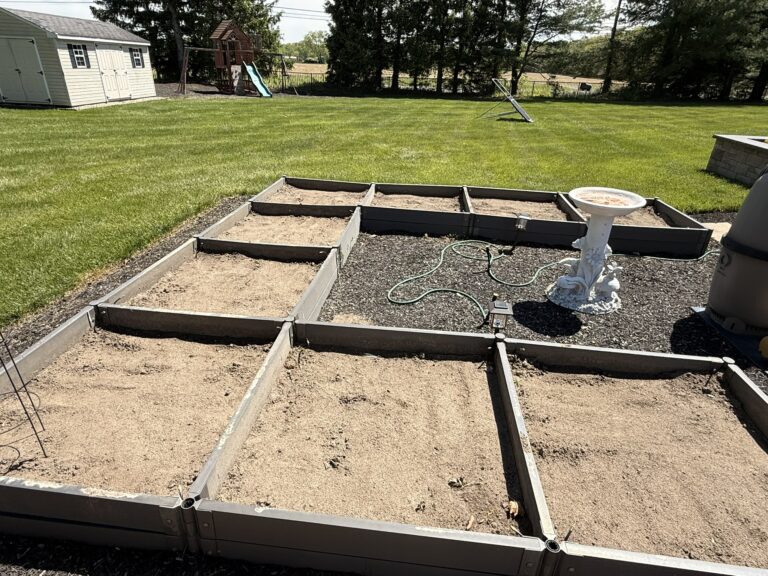
🌿 Sage Note: The final product is still a bit of a rough draft. The soil is left over from last year and likely is missing nutrients that will need to be replaced. There is also a huge benefit to adding in some fresh garden soil and turning it over to get a decent mixture. Now that we have a clean slate, the next series will cover prepping the soil, garden layout and planting for the season. It already feels like a weight has been lifted.
A Note on the Season
Spring preparation is not glamorous work. There are no blooms yet, no harvest, nothing to show a visitor and point to with pride. What you are doing in these weeks is entirely structural — clearing the past, creating conditions for what comes next.
But there is something deeply satisfying about a well-prepared garden. The dark, clean soil. The defined edges. The shapes emerging from what was, two weeks ago, a tangle of last year’s remnants.
That is the work. And these are the tools that made it possible.
Save this guide for your weekend garden reset