🌿 Structural Integrity: Understanding Your Shrubs Before You Prune
Disclosure: This post contains affiliate links. If you purchase through these links, I may earn a commission at no additional cost to you.
Moving through the garden now, the shift is noticeable. The soft work of clearing and cutting back perennials gives way to something more permanent — the shaping of structure.
Shrubs and woody ornamentals form the framework of your landscape. Managed well, they create balance and proportion. Left unchecked, they quickly become dense, tangled, and unproductive. But before you reach for a single tool, the most important step happens in your head, not your hand.
The Golden Rule
Before making a single cut, determine when your shrub blooms. You can use this as a guide to determine if the visible wood has life left in it this year to produce new growth.
- Spring-blooming shrubs (lilac, forsythia, azalea) flower on old wood — prune them shortly after blooming, not before, or you’ll cut off this season’s show.
- Summer-blooming shrubs (butterfly bush, rose of Sharon, panicle hydrangeas) flower on new wood — these are your focus right now, while they’re still dormant or just waking up.
When in doubt, wait and watch. One season of observation tells you more than any plant tag.
The Three D’s
Every pruning session begins the same way, regardless of shrub type:
- Dead — brittle, hollow, or completely lifeless stems
- Damaged — broken canes, torn bark, anything that won’t recover cleanly
- Diseased — discolored wood, cankers, anything that looks off
Removing these three things first immediately improves airflow and allows the plant to redirect its energy toward healthy growth. You’ll often find that addressing just the Three D’s opens up a shrub dramatically — sometimes that’s all it needs.
🌿Tool Spotlight – Folding Pruning Saw
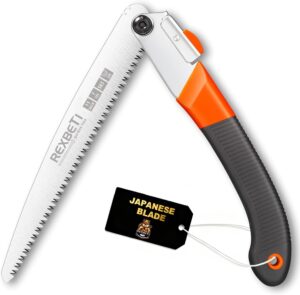
For branches that sit between pruner and lopper range — or anything truly dense — a folding pruning saw is the right answer. Unlike a bow saw or a large blade, a folding saw tucks away safely, fits in a back pocket, and deploys quickly when you hit a branch mid-session that requires more than loppers can offer. The blade cuts on the pull stroke, which gives you control and keeps the cut clean.
What to look for:
- Triple-ground teeth for aggressive, clean cuts through hardwood
- Locking mechanism — critical for safety when the blade is open
- Comfortable handle that doesn’t slip when the wood is tough
👉 It’s the difference between forcing a cut and making one.
A Note on Hydrangeas Specifically
Because they’re so common and so commonly mishandled, it’s worth addressing hydrangeas directly. The confusion usually comes from having the wrong type:
- Bigleaf hydrangeas (Hydrangea macrophylla — the big round mopheads) bloom on old wood. Prune after flowering, or just remove the Three D’s in spring.
- Panicle and smooth hydrangeas (H. paniculata and H. arborescens — PeeGee, Limelight, Annabelle) bloom on new wood. Cut them back hard in early spring.
Check your variety before you commit.
Thinning vs. Shearing
One of the most common mistakes in shrub care is reaching for hedge shears and clipping everything into a tight ball. While that may look tidy short-term, it creates a dense outer shell that shades out the interior and forces weak, twiggy growth.
Instead, focus on thinning. Reach into the interior and remove older canes at the base. This:
- Encourages vigorous new growth from the ground up
- Keeps the plant open so light and air can reach the center
- Preserves the shrub’s natural shape rather than forcing an artificial one
Work slowly. Step back often. You’re editing, not sculpting.